
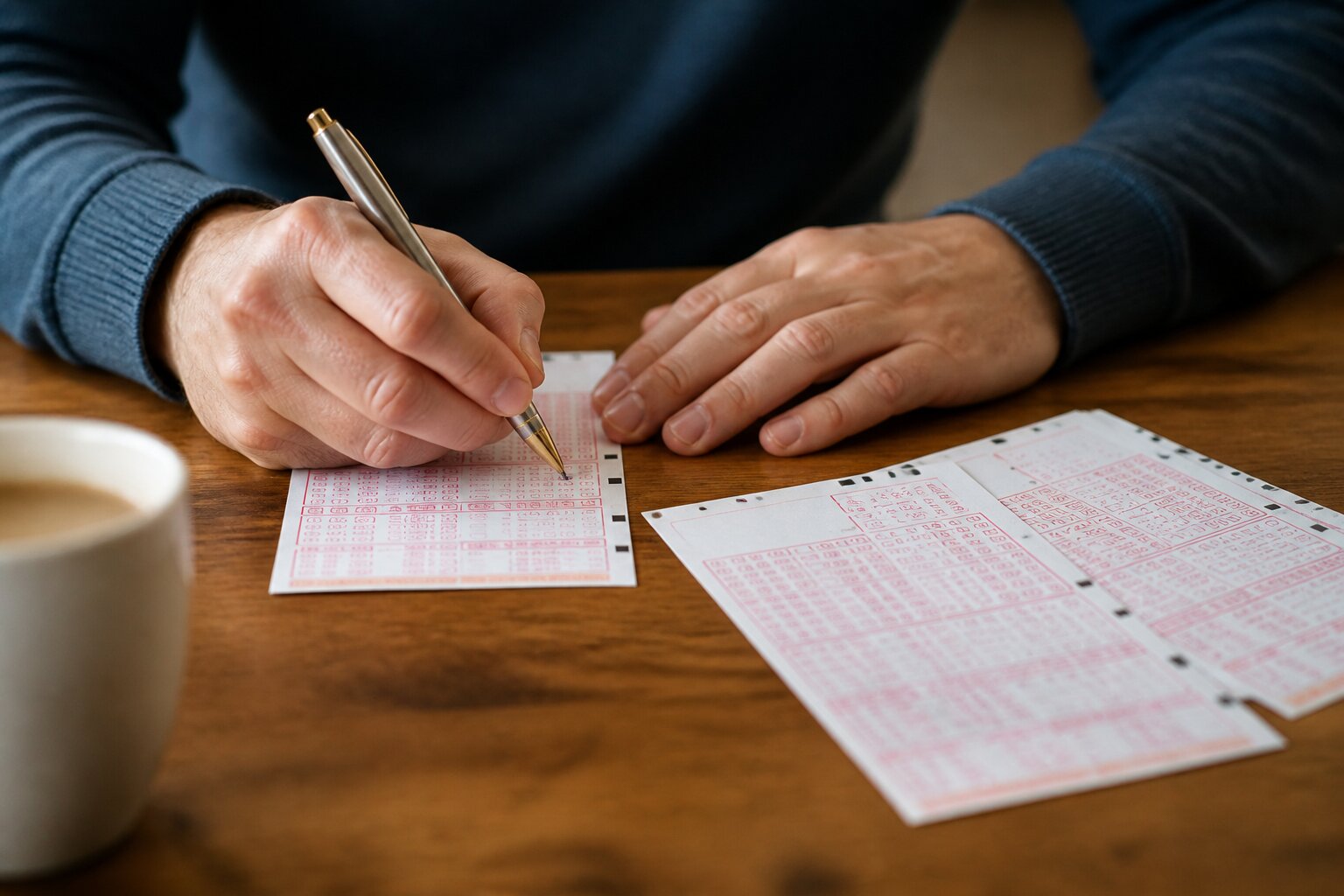
Ever wondered if there’s a secret formula for winning the lottery? You might have heard people talk about buying 27 tickets to guarantee a win, but is there any truth to this claim?
The idea sounds tempting—imagine never having to leave a lottery draw empty-handed again. Before spending money on dozens of tickets, it helps to examine where the theory comes from and what the maths actually says.
Ready to uncover the truth? Keep reading to learn what’s behind this popular lottery claim and what it means for anyone who plays.
How Do Lottery Odds Work in the UK?
UK lottery games use a random number draw system. Each ticket you buy is an independent entry with the same probability of matching the drawn numbers. The process is regulated to ensure fairness and unpredictability, so no ticket has a built-in advantage over another.
Odds express the chance of a particular outcome. For example, matching all six main Lotto numbers has odds of roughly 1 in 45 million. Smaller prizes, such as matching three numbers, are far more likely, but the top prizes remain extremely improbable for any single ticket.
Because draws are random and regulated, nothing you do—how you pick numbers, how many tickets you buy, or when you enter—changes the underlying probabilities of each ticket. Buying more entries increases the number of attempts, but it does not alter the per-ticket chance of success. This basic fact sets the stage for evaluating claims that a fixed number of tickets, such as 27, can guarantee a prize.
If you want to see why that number is so far from sufficient, the next section looks at how 27 tickets compare to the total number of possible combinations.
Can Buying 27 Tickets Really Guarantee a Win?
Buying 27 lottery tickets cannot guarantee a win. The number 27 might cover a range of different combinations, but UK lotteries commonly involve millions of possible combinations. Covering a tiny fraction of those combinations does not ensure any prize.
Each ticket remains an independent entry with the same probability of matching the drawn numbers, so even several tickets together are only a small increase in overall opportunity. To guarantee a jackpot in a game with millions of combinations, one would need to purchase every possible combination—a practical and financial impossibility for the vast majority of people.
Because no finite set like 27 covers the universe of combinations, any guarantee claim is misleading. The sensible way to approach ticket purchases is to treat them as discretionary spending and avoid assuming they will produce a specific outcome. With that in mind, it’s also useful to look at the regulatory environment that prevents any system from promising guaranteed results.
Is It Possible to Guarantee Any Lottery Outcome?
There is no legitimate method to guarantee a particular outcome in UK lotteries. Draws are overseen by the UK Gambling Commission, which enforces strict rules so that games remain random and transparent. No person or system can predict or influence which numbers will be drawn.
Marketing or claims that imply a guaranteed win are both inaccurate and contrary to regulation. Any suggestion that a strategy can ensure a prize should be treated with scepticism. It’s worth noting that the insistence on randomness is precisely why stories about miracle systems persist: humans naturally look for patterns, but regulated draws strictly prevent reproducible patterns that would allow reliable prediction.
Understanding that guarantees aren’t possible helps clear the way for discussing common misconceptions about systems or group play that people often believe will improve their chances.
Common Misconceptions About Lottery Systems
Many myths circulate about ways to improve lottery odds. They range from simple misunderstandings about probability to outright falsehoods presented as reliable systems. These misconceptions can be perpetuated by anecdote, jargon or deliberate marketing, and they often give a false sense of control over an essentially random process. Sorting fact from fiction helps people make informed choices and avoid unnecessary expense.
Do More Tickets Increase Your Chances Significantly?
Purchasing additional tickets does increase your number of attempts, but the gain is proportional and usually small in relation to the total number of combinations. Buying ten tickets rather than one does mean ten chances instead of one, but when the total combination space runs into the millions or more, that multiplication still leaves the chance of a jackpot at a very low level.
It is also worth noting that the marginal benefit of each extra ticket is constant per ticket, so spending large sums to buy substantially more entries produces diminishing practical returns when viewed against the size of the prize and the overall odds. For most players, any improvement in probability from buying extra tickets is unlikely to change expected outcomes in a meaningful way.
Are There Systems That Promise Guaranteed Wins?
No legal or verifiable system guarantees a win. Claims of “proven” formulas, secret number patterns or guaranteed strategies run contrary to how regulated draws operate and are not supported by probability. Lotteries are designed so that each draw is independent, and past results do not influence future outcomes.
Such claims should be viewed as misleading rather than evidence-based. Anyone who encounters strong assertions of guaranteed success should be cautious and consider the lack of empirical support behind those promises.
Is Syndicate Play a Safe Bet?
Syndicates pool resources so a group can afford more entries. This raises the group’s total number of tickets and therefore the group’s chance of any prize, but it does not create a guarantee. When a syndicate wins, the prize is divided among members, which reduces each individual’s share and can mean that a once-large headline prize becomes a modest personal payout.
Syndicates can be a social way to play, offering more excitement and a shared experience, but they carry the same probabilistic limitations as individual entries. It is also important for groups to agree clear rules about contributions, ticket ownership and prize distribution to avoid disputes if a win occurs.
Having examined these misconceptions, the next question for many people is what financial and personal risks come with buying many tickets.
What Are the Costs and Risks of Bulk Ticket Purchases?
Bulk ticket buying can become costly very quickly. At typical per-ticket prices, the outlay for dozens or hundreds of tickets can be substantial, with no assurance of a return. That expense should be weighed against the low probability of winning top prizes when purchased combinations still represent a negligible portion of the total.
There is a real risk of losing the money spent on tickets. Spending large sums on the expectation of a big win can lead to financial pressure, especially if it becomes habitual. It’s advisable to set a personal limit and stick to it so that play remains a discretionary cost rather than a source of strain.
Beyond direct financial risk, bulk purchasing can create practical issues: managing many tickets, tracking numbers, and claiming any prize can be administratively cumbersome. Those considering group purchases should also agree clear rules about prize distribution and record-keeping to avoid disputes.
Understanding these costs leads naturally into the legal and ethical rules that govern how people should participate.
Legality and Ethical Considerations in Lottery Participation
Participating in UK lotteries is legal for adults aged 18 and over, and operations are governed to protect players and ensure fair conduct. Age checks, transparency in draw procedures, and safeguards against fraud are all part of the regulatory framework.
Attempting to influence results, engaging in fraudulent schemes, or enabling underage play are illegal and carry serious consequences. Ethical participation means following the law, respecting other players, and being honest about how prizes are shared in groups. These rules help maintain trust in the lottery system and protect vulnerable people.
Having covered legalities, it’s useful to consider what real players report about buying multiple tickets and whether those stories support any guaranteed-win idea.
Real-Life Experiences: Does Anyone Actually Win This Way?
Anecdotes of multiple-ticket purchases resulting in wins do exist, but they’re not evidence of a reliable strategy. Often these stories involve modest prizes from matching a few numbers rather than the jackpot, and sometimes group purchases lead to small shared wins. There are no verified, repeatable cases where bulk purchasing consistently produced guaranteed large prizes.
Such accounts are informative as examples of possible outcomes, but they don’t change the underlying probabilities. Most people who buy several tickets do not win substantial amounts; many win nothing at all. These real-world experiences reinforce that expectation management and prudent spending are more sensible than chasing a perceived system.
If you’re aiming to enjoy lottery play without undue risk, there are safer, clearer ways to approach it.
Safer and Smarter Ways to Enjoy the Lottery
A constructive approach is to decide on an affordable limit for ticket spending and to view that expenditure as discretionary entertainment rather than an investment plan. Using available player tools—like spending limits or temporary account suspension—can help keep play within personal boundaries and reduce the chance of developing problematic patterns.
Staying informed about the actual odds and being sceptical of guarantees keeps expectations realistic. If play ever becomes a source of worry, support services can provide confidential advice and assistance.
Balancing enjoyment with caution preserves the positive aspects of participation while reducing potential harm. Having set this baseline of sensible play, the final section pulls the main points together so you can move forward with clear understanding.
Summary: The Truth About 27 Tickets and Guaranteed Wins
The claim that buying 27 tickets will guarantee a lottery win is unfounded. Because draws are random and the combination space is very large, any fixed set of tickets covers only a minute portion of possible outcomes. No purchase strategy can override the probabilities that govern the games.
Practical considerations—costs, administrative burdens, and the absence of guarantees—mean that sensible spending limits and clear expectations are the best ways to participate. Play within your means, use available safeguards to manage activity, and seek help if gambling becomes stressful.
By focusing on informed, measured participation, people can still enjoy lottery games without placing their financial wellbeing at risk.
**The information provided in this blog is intended for educational purposes and should not be construed as betting advice or a guarantee of success. Always gamble responsibly.