
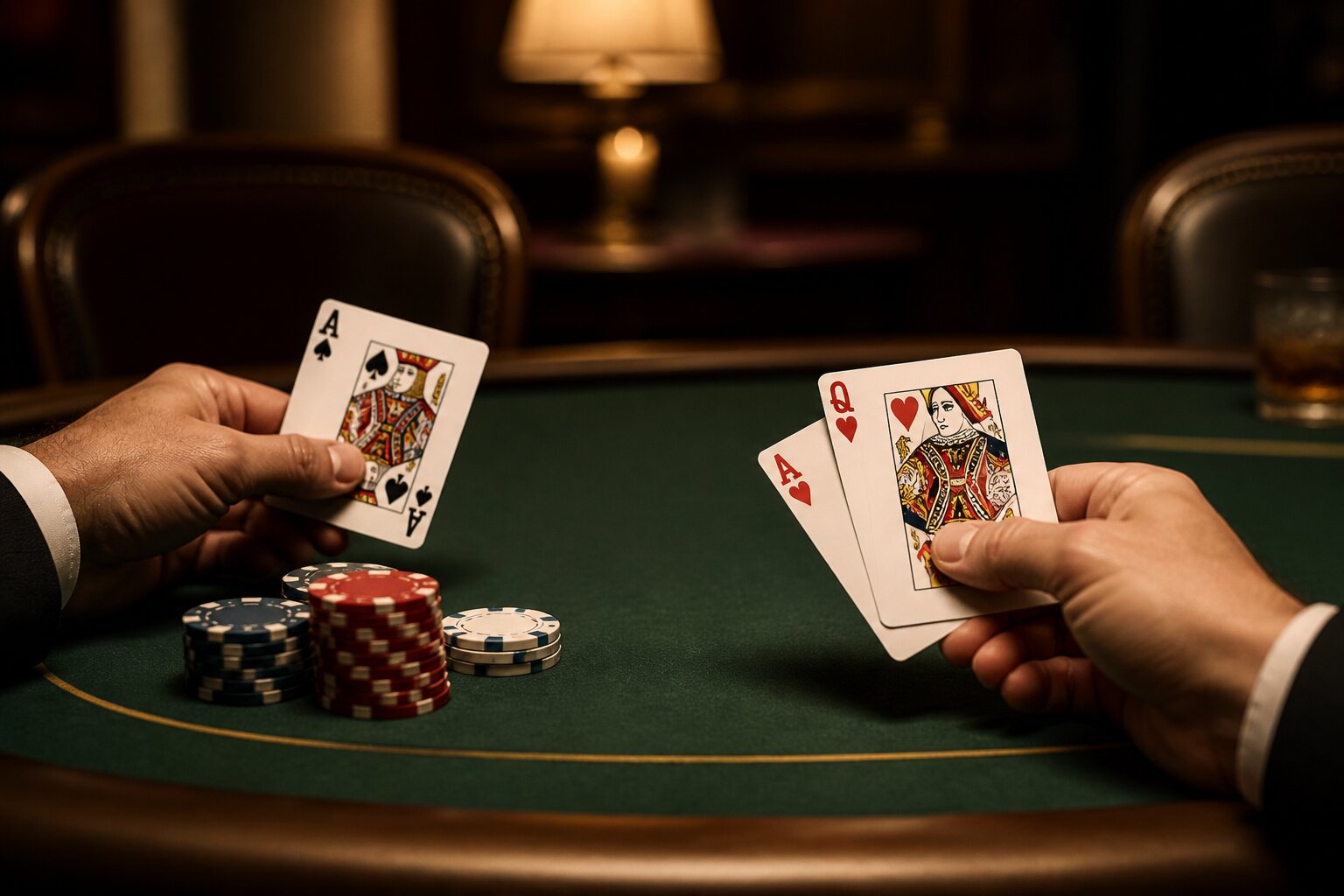
Ever wondered if blackjack and pontoon are just different names for the same game, or if they’re actually quite different? You’re not alone—many card players find the similarities confusing at first.
Whether you’ve seen blackjack at a casino, played pontoon at home, or you’re new to both, the two games share a common goal but take different approaches. Read on to learn exactly how they compare and which might suit you best.
What Is Blackjack?
Blackjack is a widely recognised card game played against the dealer, where the objective is to reach a hand value as close to 21 as possible without going over. Number cards count at face value, face cards are worth 10, and Aces can be counted as either 1 or 11, depending on what benefits the hand.
Each player and the dealer begin with two cards. The dealer typically shows one card face up and keeps the other face down. A two-card 21, made with an Ace and a 10-point card, is known as a blackjack and is the strongest possible hand.
Players choose whether to take another card or to keep their current hand, while the dealer follows set rules, often drawing until reaching at least 17. If a player’s total exceeds 21, the hand is bust and the player loses that round.
The rules and common strategies are straightforward, which helps explain blackjack’s enduring popularity in casinos and online. Set sensible limits before playing and treat the game as entertainment.
What Is Pontoon?
Pontoon is a British variant of the 21 family with its own terms and nuances. Like blackjack, the aim is to reach 21 or as close as possible without going over, but a two-card 21 is specifically called a pontoon and takes precedence over other hands.
Terminology differs: taking another card is called "twist" and keeping the hand is "stick". A five-card hand totalling 21 or less is a “Five Card Trick” and is highly valued. Unlike blackjack, both of the dealer’s cards are dealt face down, so players don’t see the dealer’s hand until the end of the round.
Players may “buy” a card at certain points—comparable to a double-down option—and may split pairs under rules that can vary by venue. Payout structures also differ: pontoon and Five Card Trick hands often pay at better rates than ordinary wins in some versions of the game.
These unique features give pontoon a distinct pace and tactical flavour compared with more familiar blackjack tables.
Are There Key Differences Between Blackjack and Pontoon?
There are several important differences that affect how each game plays and how players make decisions.
Terminology and commands are one obvious distinction, which can be confusing if you move between games without checking the rules. Another is how the dealer’s cards are handled: showing one card in blackjack gives players partial information about the dealer’s position, while pontoon’s face-down approach keeps the dealer’s hand hidden until the showdown.
Rule differences around doubling, buying, and splitting change the options available to players and can influence both risk and reward. The Five Card Trick in pontoon introduces a strategic line that simply does not exist in standard blackjack, and payout variations mean the same hand can be valued differently between the games.
Understanding these differences before you sit down helps avoid misunderstandings at the table and keeps the game fair for everyone. If you’re trying a new table, a quick check of the house rules will clarify the specifics for that session.
Which Game Is More Popular in the UK?
Blackjack tends to be more visible on casino floors and online platforms across the UK. Its straightforward rules and widespread availability contribute to its strong presence in both live and digital formats.
Pontoon tends to be more common in home games and among players who enjoy the particular vocabulary and twists that the variant offers. It appears less frequently on casino floors but remains well known among British players for its social appeal.
Both games have steady followings; the difference lies mainly in where they’re played and the type of experience players prefer. Before choosing a table, consider whether you want a conventional casino-style game or a version with slightly different rules and a more locally familiar flavour.
Can You Use the Same Rules for Both Games?
Although both games share the 21 objective, their rule sets are distinct and mixing them creates ambiguity. Small differences in wording can change how a hand is played and what options are available, so it is unwise to assume the same rules apply across variants.
Rules determine:
- player options, such as whether you can split, surrender, double down or take insurance
- dealer behaviour, for example whether the dealer draws on a soft 17 or stands
- payouts, including whether blackjack pays 3:2, 6:5 or another rate
Applying the wrong set can therefore lead to confusion, disputes about outcomes, or perceived unfairness among players.
Casinos and card groups use clear rule lists so everyone understands how the round will be conducted. Written or agreed rules help remove uncertainty before play begins and reduce the chance of arguments over particular plays.
If a group decides to play a house variant, it is useful to confirm which rulebook applies at the start of play. Make sure all players know any departures from common practice, for example changes to shuffle procedures, deck counts, or payout differences, so decisions and expectations remain consistent for all participants.
Myths About Blackjack and Pontoon Explained
Several myths circulate about these games; separating fact from fiction helps players approach play more confidently.
One common misunderstanding is that there is a guaranteed way to win every hand. In truth, no strategy can guarantee consistent wins. Another myth is that dealers can manipulate outcomes; regulated venues operate under strict oversight and procedural checks to ensure fair play.
Card counting often gets more attention than it deserves. It is difficult to execute effectively in real-world settings and is generally discouraged or not permitted by many operators. Finally, while the games are related, their rule differences mean strategies and betting choices do not transfer directly from one to the other.
Being aware of how the games actually work prevents misplaced expectations and supports better decision-making at the table.
Choosing Between Blackjack and Pontoon: What Suits You?
Picking between blackjack and pontoon comes down to what you enjoy about a card game. If you prefer a familiar, fast-paced casino experience with visible dealer cards and widely understood rules, blackjack will likely suit you. If you like the idea of hidden dealer cards, different terminology, and additional hand types such as the Five Card Trick, pontoon offers a distinct and engaging alternative.
Think about the atmosphere you want and how rules affect tactics. For social gatherings, pontoon’s traditional terms can add character to the game; for a classic casino session, blackjack’s ubiquity makes it easy to find tables and players. Whatever you choose, set sensible limits and treat play as entertainment within those boundaries. That way you’ll enjoy the experience and make clearer choices at the table.
Choose the game that fits your style, and stick to rules you understand so every session is fair and enjoyable.
**The information provided in this blog is intended for educational purposes and should not be construed as betting advice or a guarantee of success. Always gamble responsibly.