
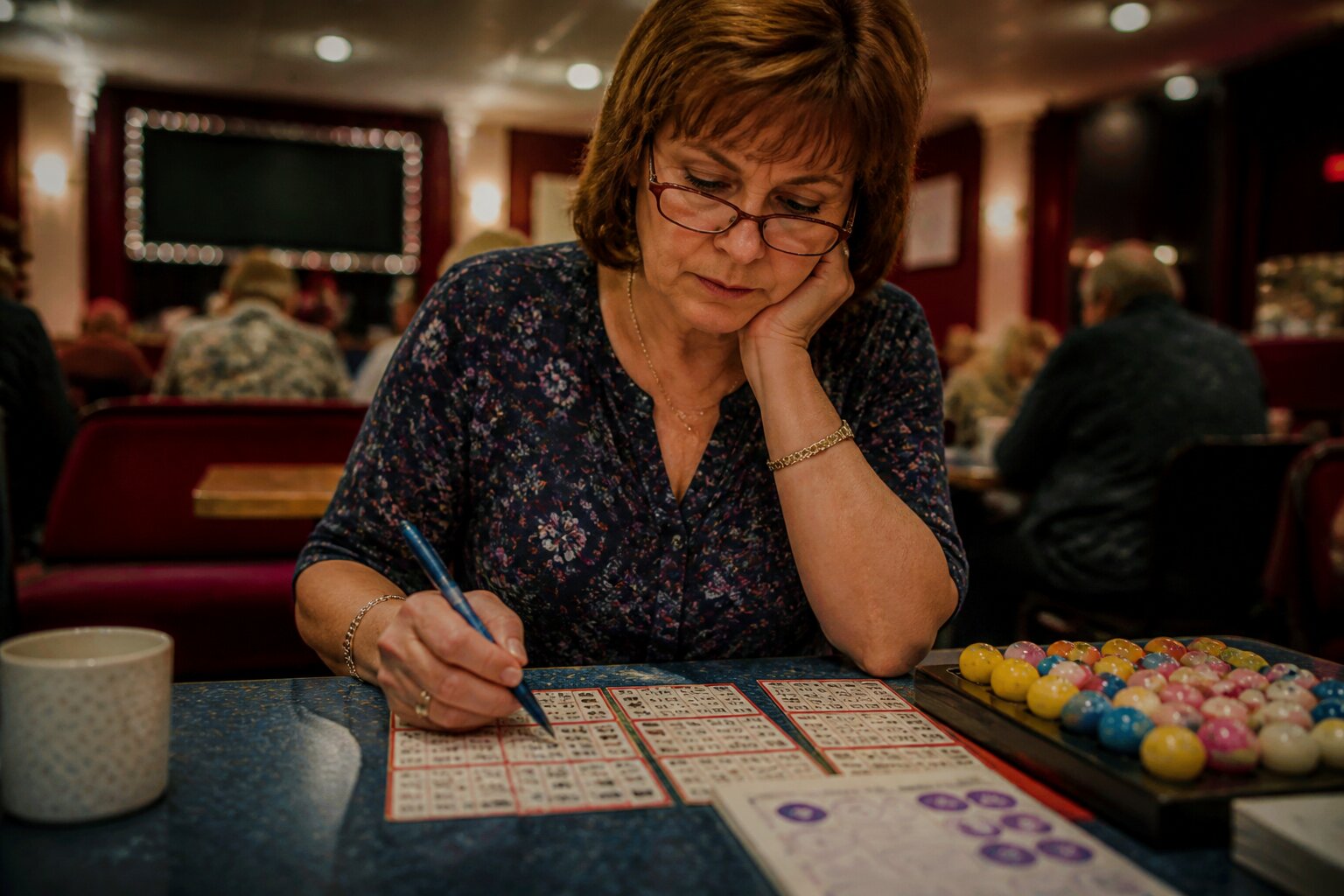
Bingo is a game of anticipation, where every call changes the shape of the game and players watch numbers with eager attention. Many people imagine there is a secret way to complete a full house in just 15 calls, and stories about surprisingly fast wins circulate often in halls and online.
This article separates fact from fiction around those early full-house claims. Read on to see what the maths actually says and which common beliefs don’t hold up under scrutiny.
Understanding Bingo Odds in 15 Numbers
In 90-ball bingo a full house means marking all 15 numbers on one ticket. To finish a full house in exactly 15 calls, every one of those first 15 numbers must match the numbers on a single ticket. That requirement makes this outcome far rarer than most casual players expect.
Mathematically, there is exactly one specific set of 15 numbers that will complete a given ticket in the first 15 calls, while the total number of possible 15-number combinations from 90 balls is 2,936,681,695. That produces odds of approximately 1 in 2,936,681,695 for a single ticket to win in exactly 15 calls. Buying multiple tickets increases the number of possible winning sets you hold, but the improvement is marginal in practical terms: even holding many tickets leaves the event extremely unlikely because each draw is random and independent.
These figures are long-run probabilities rather than guarantees for any single session and they explain why a 15-call full house is treated as an exceptional event rather than an everyday occurrence. With that clear picture of how improbable it is, the next section looks at the common myths that grow up around these rare wins.
What Are the Most Common Myths About Bingo Odds?
One persistent myth is that buying more tickets guarantees a win. While additional tickets raise the overall chance of winning at some point during a session, they do not ensure a full house in exactly a set number of calls. Each ticket still faces the same random process when the balls are drawn.
Another widespread idea is that certain numbers appear more often than others. In properly run bingo, every number has the same chance of being drawn on each call, so frequency claims are usually the result of selective memory rather than a true pattern.
People also talk about certain times or seats being better for winning. There is no mechanism by which where someone sits or what session they choose affects the draw, so these beliefs do not change actual odds.
Finally, some suggest that systems or patterns will reveal which cards are best. Because tickets are filled at random and draws are independent, no predictive method can reliably influence outcomes. Understanding these myths helps to separate hopeful thinking from what the probabilities actually permit. The next part examines the stronger claim—that a guaranteed 15-call win is possible—and explains why it cannot be done.
Debunking the Belief: Is It Possible to Guarantee a Win in 15 Numbers?
A guaranteed full house in exactly 15 calls is not possible. The random nature of each draw means outcomes are not under a player’s control, and there is no combination of ticket purchases or selection techniques that can force this precise result.
The Role of Probability in Bingo Draws
Each call in a bingo game is an independent random event. The chance of completing a full house in the first 15 calls for a single ticket is roughly 1 in 2.94 billion. Adding tickets increases the number of sets you hold but does not alter the underlying probabilities that make a 15-call full house vanishingly rare. Because the maths is fixed, no pattern or timing will change it.
This understanding of probability also explains why reports of rapid wins create so much attention: improbable events do occur from time to time, but they remain exceptional by definition. Looking next at ticket counts and their real effect helps clarify what buying more cards actually achieves.
Misconceptions About Ticket Quantity and Winning Odds
Buying more tickets does increase the chance that at least one ticket will complete a full house at some point during a session, but it will not make an early 15-call win materially likely in practical play. Even holding dozens or hundreds of tickets rarely moves the needle enough to make that specific outcome probable.
Operators and games are structured so prizes, ticket sales and payouts balance over many sessions. That balance means individual players should treat purchases as entertainment spend rather than a path to a predictable, short-term payout. With this in mind, players can make choices that suit their budgets and expectations, and the next section explains why methods based on ticket layout or number distribution do not offer a reliable edge.
Do Patterns or Systems Improve Your Chances?
Some players favour buying strips of tickets to cover a wider range of numbers, or they select tickets where numbers appear more evenly spaced. While these approaches change what number combinations a player holds, they do not change the fact that every draw is random and independent.
For example, a full strip of six tickets in 90-ball bingo ensures you hold every number from 1 to 90 once across those tickets, so you will win a full house sometime during a complete run of draws. However, this does not make a full house more likely in the first 15 calls than it would be for any other set of tickets; it simply shifts which draws could produce a win. Claims that frequency, spread or layout deliver a dependable advantage are not supported by the mechanics of a random draw.
If a player wants to think in terms of coverage or variety, doing so can be reasonable for personal preference, but it should not be mistaken for a method that alters mathematical probability. The discussion now turns to how operators’ long-term payout figures relate to individual sessions.
Exploring House Edge and RTP in Bingo
House edge refers to the portion of all stakes retained by the operator, while Return to Player (RTP) is the share expected to be returned as prizes over the long run. Typical RTP ranges for bingo sit around 80% to 85%, which implies a house edge of roughly 15% to 20% depending on the precise game and prize structure.
These percentages are averages across many sessions and players, not guarantees for any one game. For instance, an 85% RTP indicates that, over a very large number of games, about 85p of every £1 staked is returned in prizes. Short-term sessions can deviate widely from that average; individual players may see much higher or lower returns in a single afternoon.
Knowing RTP and house edge helps set realistic expectations about likely returns across time. With the financial framework clear, it becomes easier to understand why highly memorable fast wins shape perceptions more than the much quieter, far more common outcomes — which is the focus of the next section.
Why Do So Many Players Believe in 15-Number Wins?
Memory bias and social sharing explain much of this phenomenon. Dramatic examples, such as a very quick full house, stick in the mind and are more likely to be shared with friends or on social channels, creating a sense that they happen frequently. When rare events are highlighted, they skew our sense of how often they actually occur.
Psychological factors like confirmation bias also play a part. A single dramatic experience can create a lasting impression while the many ordinary sessions pass without notice. Community excitement and storytelling amplify these effects, and that is why it is important to prioritise clear information about probability and expected returns when considering playing choices.
Understanding the real odds and the nature of chance helps put memorable anecdotes in context and supports decisions that match personal preferences and budgets. This brings the discussion to a close with the simple reality that 15-call full houses are extraordinary events—interesting to discuss, but not a reliable expectation for any player.
Enjoy Slots at Rose Slots
At Rose Slots, you’ll find plenty of choice with a wide range of casino games to explore and enjoy at your leisure. We’re here to provide a friendly and welcoming place for everyone who loves a relaxed bit of play.
Getting started couldn’t be more straightforward—just create your account, make a deposit and you’ll be able to begin your experience with us.
**The information provided in this blog is intended for educational purposes and should not be construed as betting advice or a guarantee of success. Always gamble responsibly.