
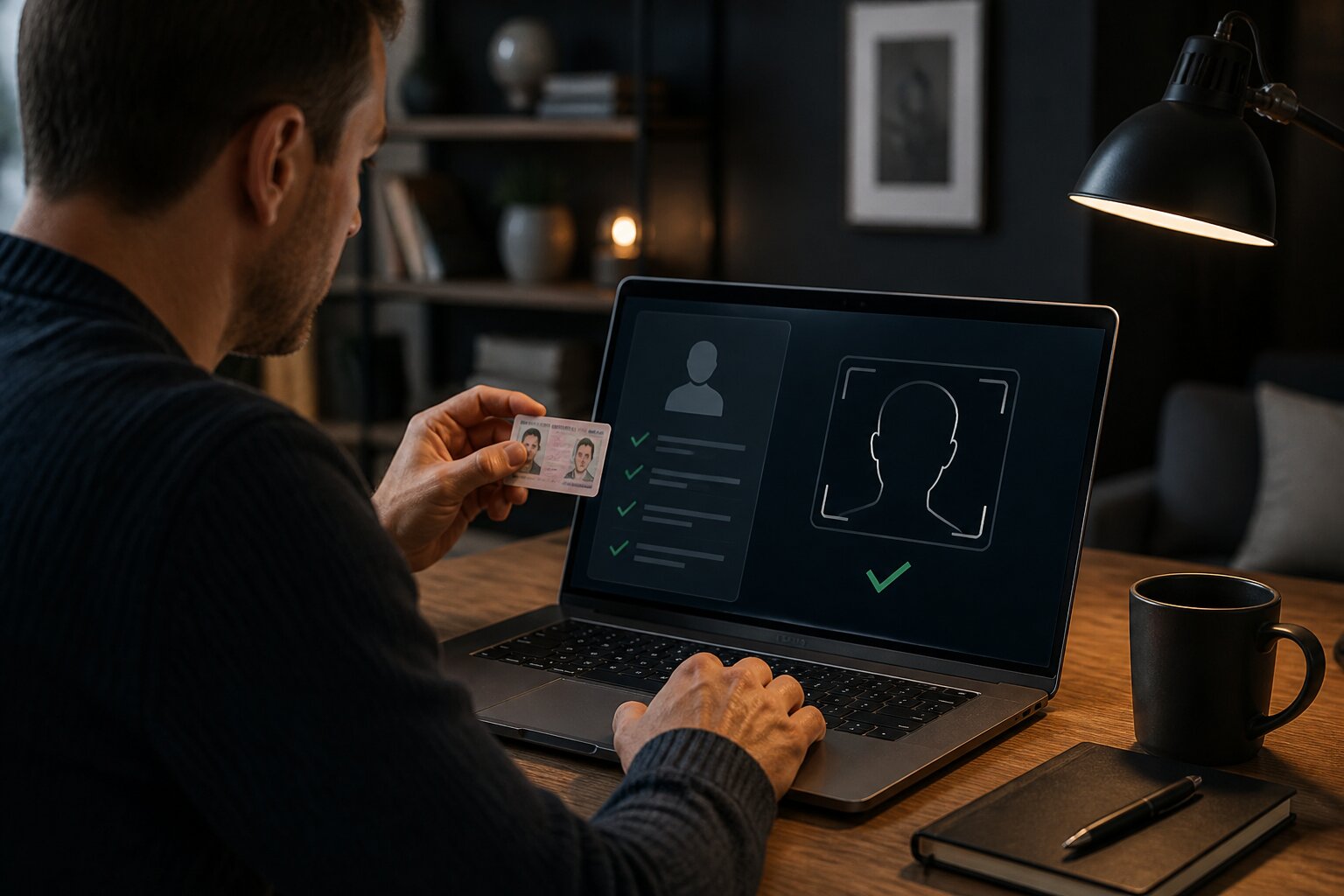
Ever had to upload a copy of your driving licence or take a selfie with your passport before you could play at a new online casino? It can feel like a lot of paperwork when all you want is to try a game, but there are important reasons behind those checks.
Casinos need to confirm who you are, your age, and where you live before they allow real-money play or pay out winnings. These checks are part of a wider legal and safety framework designed to keep transactions and accounts secure.
What follows explains how these checks work, why they matter, and what to expect if a site asks you to verify your identity.
What Is ID Verification at Online Casinos?
ID verification at online casinos is the process of confirming a player’s identity, age and address before allowing certain account actions such as depositing, placing bets or withdrawing funds. Typical documents used include a passport, driving licence or national ID to prove identity, and a recent utility bill, bank statement or council tax letter to confirm address. Photos should be clear and dated within the required time window.
Many sites also require a selfie holding the ID or a redacted image of a bank card to verify ownership of payment methods. The upload usually happens through the casino’s secure platform and is reviewed by trained staff. Most checks are completed within hours to a couple of days, although unclear or mismatched documents will lengthen the process.
Knowing what documents are commonly requested makes verification smoother and reduces delays when you request a withdrawal. With that in mind, the next section looks at how these measures protect both players and operators.
How ID Verification Protects Players
Verification acts as a barrier against unauthorised account access and identity theft. By matching a photo ID to account details and evidence of address, casinos can detect and block attempts by others to open or use an account in someone else’s name. That prevents fraudulent withdrawals and financial loss to the real account holder.
The process also reduces the risk of duplicate or multiple accounts being used to exploit sign-up offers or bonuses, which helps maintain fairness across the player base. Crucially, confirming age and identity prevents attempts to register by people who are not legally eligible to play, and supports schemes that keep excluded individuals from re-registering under different details.
These protections combine to make the playing environment safer for everyone, and they set the scene for why the law requires operators to perform verifications — which is explained next.
Legal Obligations & Regulatory Requirements
Operators must perform identity checks because of legal obligations designed to prevent financial crime and to protect consumers. Anti-money laundering (AML) and know-your-customer (KYC) rules require casinos to verify who their customers are, how they fund accounts, and whether any activity appears suspicious.
Breaching these requirements can lead to regulatory fines, enforcement action, or licence revocation, so licensed operators build verification into their onboarding and transaction processes. The checks also meet the duty to prevent underage gambling and to honour exclusions where applicable.
Why Do Casinos Need to Check Your ID?
ID checks prove that payouts go to the correct person and help detect attempts to introduce illicit funds into the gambling system. When requested, documents that confirm identity, address and payment method are used to demonstrate that a customer is legitimate and that large or unusual transactions have a lawful source. This provides assurance to both the operator and to regulators that activity on the account is legitimate.
Carrying out these checks is part of staying compliant with the law; failing to do so exposes an operator to penalties and undermines consumer protection.
Which Authorities Oversee Online Casinos in the UK?
The primary regulator for gambling operators in Great Britain sets the rules, issues licences and enforces standards that include identity checks and AML controls. Operators may also liaise with financial regulators or law enforcement if criminal activity is suspected, ensuring a coordinated response when serious issues arise.
Knowing which bodies oversee compliance helps explain why verification procedures are both rigorous and widely applied across the market. The next section examines how these procedures stop fraud and underage play in practice.
Preventing Fraud & Underage Gambling
Verification helps spot common fraud indicators, such as mismatched documents, unusual payment patterns, or multiple registrations from the same device or address. Where discrepancies appear, accounts can be suspended pending further checks and, if necessary, authorities notified. That immediate response limits the damage from stolen cards or identity misuse.
Proving age and identity prevents minors from accessing real-money games and means operators can enforce exclusions effectively. Where uncertainty remains, access is refused until satisfactory evidence is provided. These safeguards protect vulnerable groups and ensure the operator remains within its legal duties.
Detecting suspicious activity often requires combining identity checks with monitoring of account behaviour, which leads naturally into how personal data is handled securely during all of this.
Data Protection: How Is Your Information Kept Safe?
Personal documents submitted for verification are treated as sensitive information and handled under strict data protection laws. Casinos apply industry-standard encryption when you upload files and when those files are stored, limiting access to authorised personnel only. Staff access is audited, and data retention follows legal and regulatory requirements, meaning information is kept only as long as it is needed.
Operators must also be transparent about what they collect and why, and they should provide contact details for data queries or requests. If a third party needs access because of a legal obligation, that sharing is constrained by law and logged. These measures balance the need for verification with a duty to respect player privacy.
Understanding how data is protected helps explain why verification can sometimes take time — especially when a careful review is needed — and that is relevant to how withdrawals are handled.
Does ID Verification Affect Withdrawal Times?
Yes. Withdrawals are typically not processed until the operator is satisfied identity and address checks are complete. If an account is already verified, withdrawals may be processed quickly within the operator’s stated timescales. If not, a request for documentation will pause the payout until verification is finished.
Common causes of delay include unclear or expired documents, mismatched names or addresses, or the need to confirm the source of funds for larger sums. When further information is required, the operator will explain what is needed and the withdrawal stays on hold until the review concludes.
These safeguards protect players and operators by ensuring funds are paid to the correct person and that transactions comply with legal obligations. With verification complete and records in order, normal account activity resumes and funds can be released in line with the operator’s processing times.
Enjoy Casino Games at Rose Slots
We’d love for you to experience the fun of playing casino games with us at Rose Slots. Our site is open to anyone looking for a friendly and welcoming place to enjoy a bit of entertainment at your own pace.
Getting started couldn’t be easier: simply create an account, make a deposit and you’ll be ready to play. We’re always here to offer you a safe and enjoyable experience whenever you choose to join us.
**The information provided in this blog is intended for educational purposes and should not be construed as betting advice or a guarantee of success. Always gamble responsibly.