
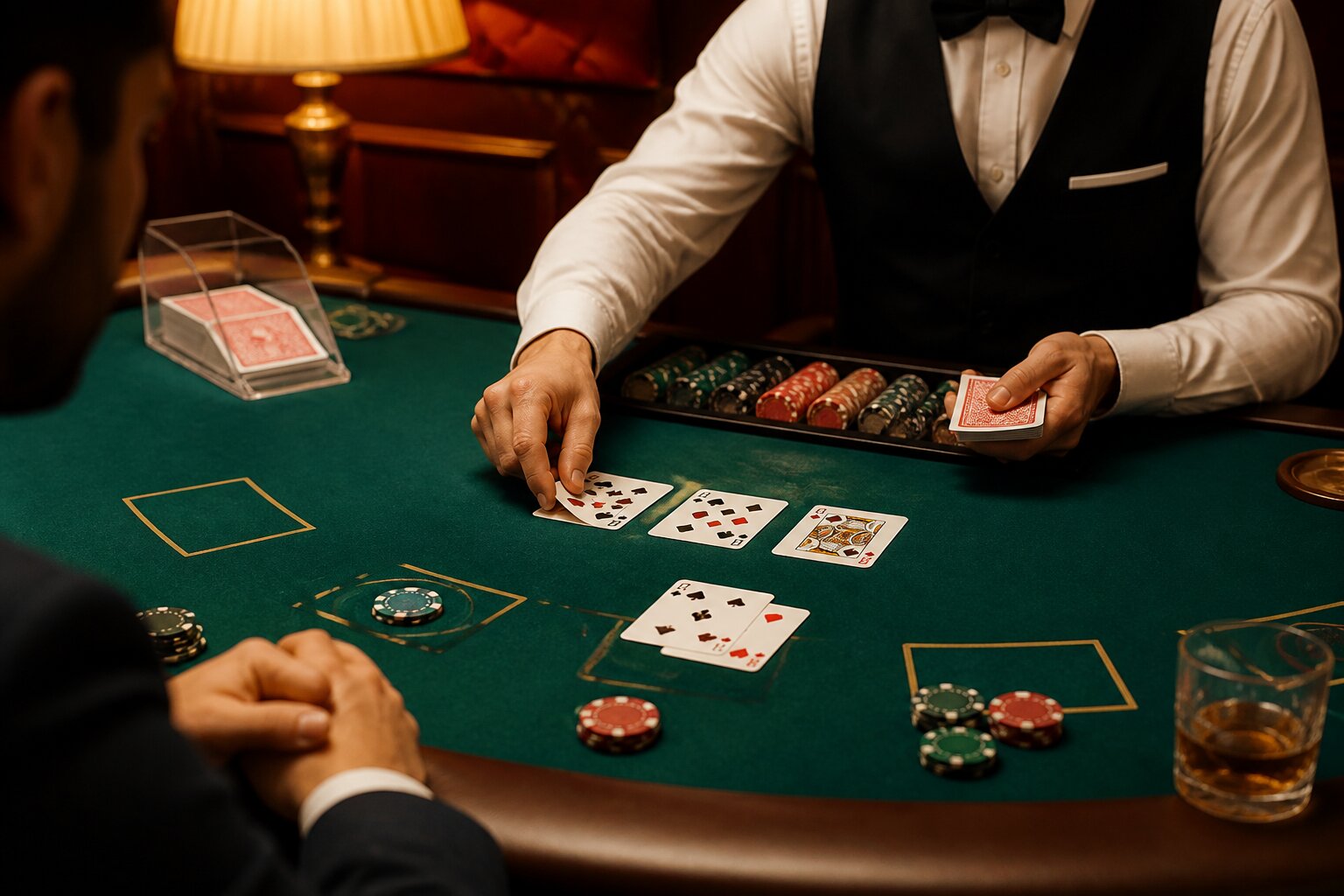
Ever found yourself at the blackjack table, hearing other players shout things like “double down,” “snap up a soft hand,” or “go bust,” and wondered what they mean? You’re not alone. Blackjack attracts both beginners and experienced players, and the game comes with a shorthand that helps everything move quickly.
Getting to grips with the lingo makes playing easier and helps avoid awkward moments where you’re not sure what’s happening. Before you place your next chip on the felt, brush up on the terms that commonly fly around the table so you can follow the action with confidence.
Why Do Players Use Slang in Blackjack?
Slang speeds up play and reduces confusion. Short, standardised phrases such as “hit” or “stand” mean everyone knows what’s happening without lengthy explanations, which keeps rounds moving at the right pace. Dealers and players favour compact words because they’re precise and minimise misunderstandings.
There’s also a long tradition of table talk in blackjack, with many expressions handed down over decades. That helps create a shared feel at the table and makes it easier for newcomers to pick up the flow. Next, we’ll look at the essential terms you’re most likely to hear.
Essential Blackjack Slang: The Most Common Terms Explained
Blackjack has a handful of core terms that form the backbone of play. Each one tells the dealer and other players what action you want or describes a particular result. Below are the most important entries, with clear examples to make them easy to remember.
Blackjack: An Ace plus a 10-value card (10, Jack, Queen, or King) on your first two cards. Example: “I’ve got blackjack!” means you have a natural 21.
Hit: Asking for another card. Example: “Hit me” signals the dealer to deal another card to your hand.
Stand: Choosing not to take any more cards. Example: “I’ll stand on 18” means you’re content with that total.
Bust: A hand total that exceeds 21 and therefore loses. Example: “I’ve bust” shows the hand has gone over the limit.
Double Down: Doubling your original bet, taking exactly one more card, and then standing. Example: “Double down on 11” is a common play when one extra card could create a strong total.
Split: Splitting two cards of the same rank into two separate hands by placing a second bet equal to the original. Example: “Split the eights” separates them into two hands each played independently.
Push: A tie between your hand and the dealer’s; your stake is returned. Example: “It’s a push” means no win or loss.
Surrender: Electing to give up your hand and forfeit half your bet; not all tables allow this. Example: “Surrender on 16 against a dealer’s 10” can limit a larger loss when the odds are poor.
Soft Hand: Any hand containing an Ace counted as 11, which can be converted to 1 to avoid busting. Example: “Soft 17” could be Ace and 6.
Hard Hand: A hand with no usable Ace counted as 11, or where the Ace must count as 1. Example: “Hard 18” might be a 10 and an 8.
Knowing these terms makes it straightforward to follow each round and communicate clearly at the table. The next section explores some of the rarer, more colourful phrases you might still hear from time to time.
Unusual Blackjack Phrases and What They Mean
Beyond the essentials, players sometimes use quirky phrases that add flavour to the game. These terms aren’t necessary to play, but recognising them keeps you in step with more experienced players.
Monkey: A casual nickname for any 10-value card (10, Jack, Queen, King). Example: “Give me a monkey!” when hoping for a 10.
Stiff Hand: A hand totalling between 12 and 16 that’s awkward to play because drawing may cause a bust. Example: “That’s a stiff hand—tricky position.”
Painting the Table: A run of face cards appearing in quick succession. Example: “The table’s being painted tonight” if a series of Jacks, Queens or Kings turn up.
Cold Deck: A phrase for a sequence of hands where the cards are unfavourable to a player or group, leading to several losses in a row. Example: “It’s a cold deck” after a stretch of losing hands.
Snapper: An older, informal word for a natural blackjack. Example: “Nice, a snapper!” though today most people simply say “blackjack.”
Breaking the Table: A celebratory expression used when someone wins a substantial amount or has an exceptional run. It’s seldom a literal description and more of a boast.
These expressions vary by region and crowd; some tables will use them regularly, others rarely. Next, we’ll move from slang into the practical language used around the dealer, which helps the game operate smoothly in any casino setting.
Grouping of Card-Related Blackjack Terms
Many of the meaningful choices you’ll make at a table are card-related — and understanding those options helps you know what’s possible on your turn. The headings below set out the main decision verbs and clarify how soft and hard hands influence play.
What Do "Hit", "Stand", "Double Down", and "Split" Mean?
These four choices are the most frequently made decisions in a round of blackjack. Each determines how the dealer proceeds with your cards and what risks or opportunities you accept.
Hit is a request for another card to increase your total; Stand ends your turn and leaves your total as it is. Double Down means increasing the original wager, accepting exactly one more card and then standing. Split separates a pair into two hands, each with its own bet and subsequent play. For example, with two 8s a player often splits to avoid playing a hard 16 and instead chase two better totals.
Understanding how those options interact with soft and hard hands clarifies the risk in each choice and helps you anticipate how a hand might develop.
What Is a "Soft Hand" Versus a "Hard Hand"?
A soft hand includes an Ace counted as 11, giving flexibility because the Ace can revert to a value of 1 if a further card would otherwise bust the hand. For instance, Ace and 5 is a soft 16; drawing a 10 makes the Ace count as 1 and the hand becomes 16 rather than busting.
A hard hand either lacks an Ace or contains an Ace that must be counted as 1 to stop the total exceeding 21. A 10 and 7 is a hard 17. The practical difference between soft and hard matters because soft hands tolerate an additional card more safely, affecting whether a player might hit or stand. With those concepts clear, the following section explains dealer- and table-specific terms that are common in live settings.
Dealer and Table Lingo: Phrases Specific to the Casino Setting
Certain phrases are more likely to come from the dealer or are tied to the mechanics of a live table. Knowing these keeps you comfortable in a land-based casino or a live online game and helps the round proceed without hitches.
What Does "Burn Card" Mean?
A burn card is one that the dealer discards face-down after shuffling and before the deal begins. Its role is to help ensure the deck order is not obvious; the card is removed and does not influence play in that hand.
What Is a "Shoe" in Blackjack?
The shoe is a device that holds multiple decks, enabling continuous play without frequent shuffling. Casinos choose shoes with different numbers of decks, commonly between two and eight, and dealers deal directly from it to maintain a steady flow.
What Does "Colouring Up" Refer To?
Colouring up is exchanging smaller denomination chips for higher-value ones, often before leaving a table. It simplifies chip handling and makes larger sums easier to manage when cashing out.
Those table-specific terms are straightforward but useful to know. The next section looks at a few remaining terms older players sometimes mention and clarifies how they fit with modern play.
Five Card Charlie
“Five Card Charlie” describes a five-card hand that has not exceeded 21. Historically some games treated it as an automatic win, but most modern tables rely on the standard rules: a hand wins only by outscoring the dealer without busting or by having a blackjack where applicable. Expect that a five-card hand simply continues under the usual win and loss conditions at most tables.
Snapper
This older word for a natural blackjack was mentioned earlier; it’s now largely replaced by the term “blackjack” for clarity.
Stiff
As explained in the unusual phrases section, “stiff” refers to a hand between 12 and 16 that’s awkward to play; stating the numerical total is now the clearer option.
Even Money
When a player has blackjack and the dealer shows an Ace, the player may be offered “even money,” taking a 1:1 payout immediately rather than risking a push if the dealer also has blackjack. This is simply a payout choice for the player to consider and does not change the underlying probabilities of the hand.
These final terms close out the list of common and occasional expressions you might meet at the table. Knowing them helps conversations stay clear and keeps rounds moving without needless pauses.
This guide has covered the everyday slang and the less common phrases you’ll encounter in blackjack, explained the core decision terms and the differences between soft and hard hands, and clarified dealer and table vocabulary so you can join the action with confidence.
Explore Casino Games at Rose Slots
We'd love you to come and enjoy the experience with us at Rose Slots. Discover a welcoming place to play where entertainment is at the heart of what we do.
Getting set up could not be more straightforward: just create an account, add funds and you are ready to explore our range of casino games. We look forward to having you with us.
**The information provided in this blog is intended for educational purposes and should not be construed as betting advice or a guarantee of success. Always gamble responsibly.